Beyond Attendance: Measuring the Real Impact of Live Events
Attendance has always been the headline number for a live event — but a crowd estimate doesn't tell an organiser, a sponsor or a city what the event actually did. Who did it draw? How long did they stay? Did they come back? And did the activity spill out into the surrounding precinct and its businesses? Answering those questions is what modern event and precinct measurement is for.
From headcount to real-world impact
Lumos's event measurement uses geo-fenced, privacy-safe live event data to compare activity during an event against a pre-event baseline. Instead of a single attendance figure, it captures how audiences behave before, during and after the event:
Visitation and dwell — visits to the event footprint and how long people stayed
Repeat visitation — who returned across a multi-day program
Visitor origin — where audiences travelled from, by postcode
Precinct spillover — movement through and impact on the surrounding area, not just the event site
Baseline lift — whether the event drew genuinely new audiences and extended activity
Because every event is measured against its own historical benchmark, organisers get comparable data over time — not a one-off report, but a consistent way to track visitation, audience growth, engagement and precinct activation across future events.
The proof: Asia Live 2026
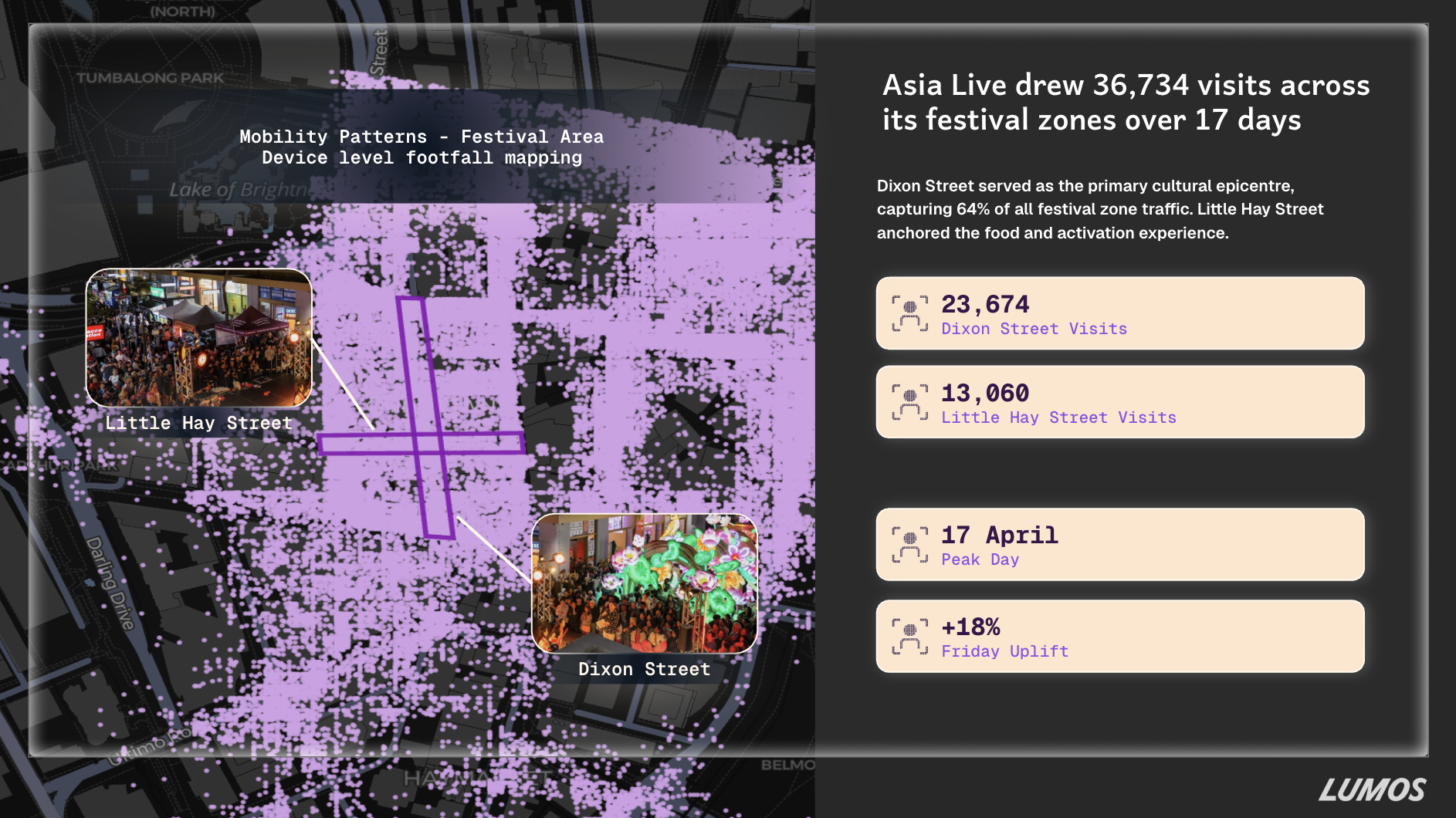
Lumos deployed the tool at Asia Live 2026, a City of Sydney festival, measuring both the festival footprint and the wider Haymarket precinct across a 16-day program. The results went well beyond a crowd count:
143,380 visits within the festival footprint
586,772 visits across the wider precinct during the event period
Non-NSW visitation up 287% against the pre-festival baseline — a sharp lift in interstate visitors compared with normal precinct traffic
Average dwell time up 17%, with median dwell time doubling during the program
One in four visitors returned on multiple days — repeat engagement, not a one-off spike
The movement data told the precinct story most clearly. Visitors dispersed well beyond the event boundary into nearby commercial areas including World Square, Darling Harbour and Central Station — activity spreading across the broader district rather than staying inside the festival footprint. Local Sydney residents still made up most of the attendance, but the event also broadened its metropolitan reach, drawing visitors from suburbs including Mascot, Liverpool and Kellyville.
Audience segmentation added another layer: the strongest-represented segments included tourism and travel, arts and culture, and family leisure — telling organisers not just how many people attended, but what kinds of audiences were reached and how that differed from normal visitation.
That gap between footprint and precinct — and the shift in visitor mix, dwell and repeat behaviour — is the story a headcount can never surface, and exactly what cities and sponsors need to justify investment.
Why it matters now
Event organisers, agencies and public funders are under growing pressure to demonstrate returns beyond attendance numbers. Ticketing records show how many tickets were issued; surveys capture a sample of opinion; but neither captures the full movement of people across a precinct. As public funding for festivals and activations comes under closer scrutiny, organisers are increasingly asked to show measurable economic, tourism and community outcomes — whether visitors entered nearby retail and hospitality, how long they stayed in the district, and whether they came back.
As Lumos CEO Eric Fan put it: "A lot of event reporting still stops at crowd estimates. That doesn't tell you whether people engaged, whether they came back, or whether the event brought new people into a precinct. What event owners really need is evidence that an event changed behaviour."
Part of omni-channel measurement
Event and precinct measurement isn't a standalone product — it's one method within Lumos's omni-channel audience measurement and attribution, sitting alongside footfall attribution for retail and out-of-home. It's all built on the same first-party and behavioural audience data, so events can be measured on the same terms as the rest of the media and marketing mix. As Lumos expands across Australia and into New Zealand, precinct-level measurement gives the market a way to prove the true footprint of an event.
Want to measure the real impact of your event or precinct? Book a demo or explore event & precinct measurement.